Ke Yang, Xin Wang, Xunjun Chen, Renshun Wang, Guangchao Geng*, Quanyuan Jiang ( * corresponding author )
Nature Communications 2025
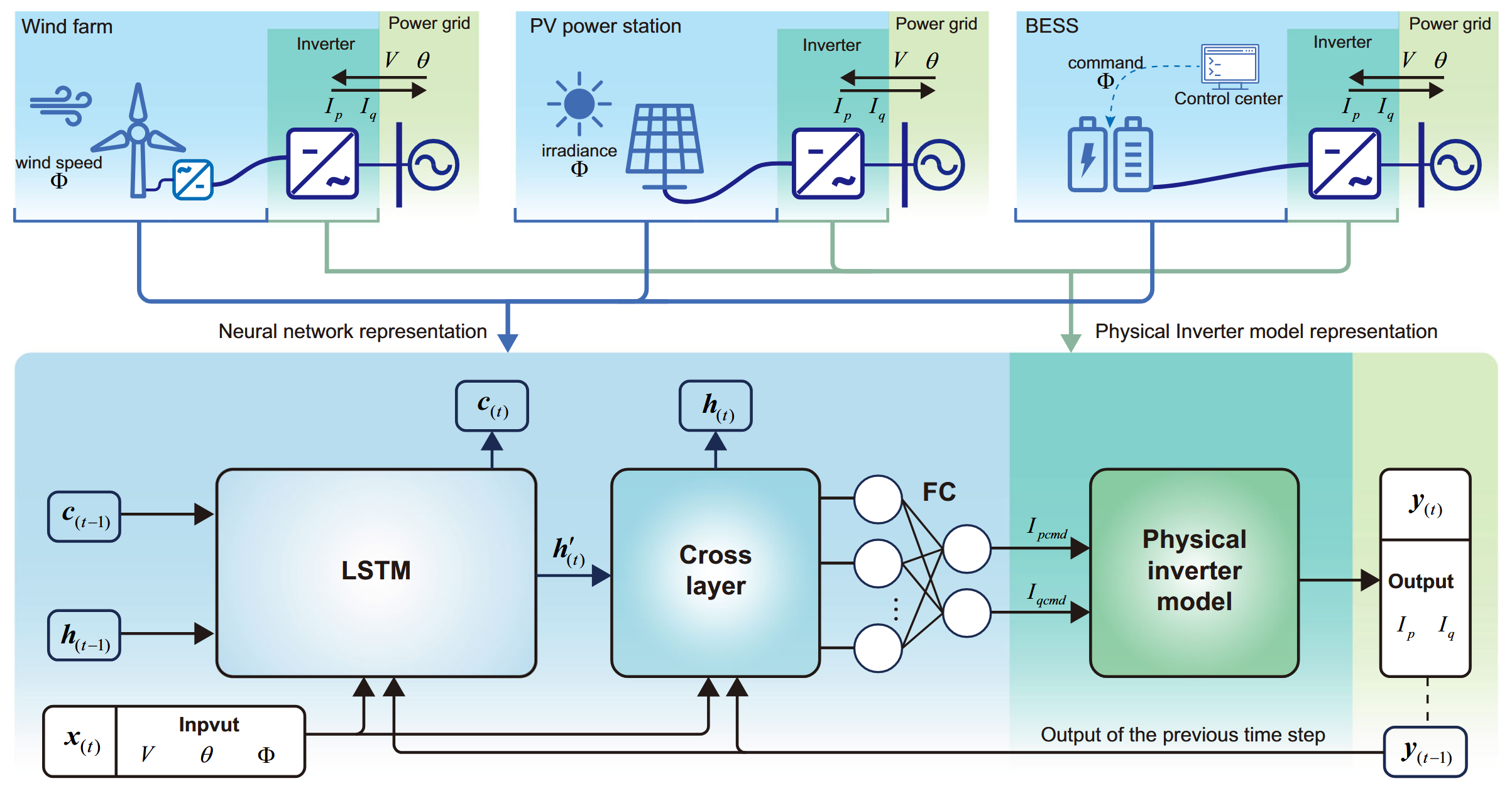
Dynamic models are a cornerstone of power system stability and control. The growing penetration of inverter-based resources, driven by global decarbonization, significantly complicates power system dynamics. For large-scale power systems, existing dynamic models of these resources have long struggled to accurately capture their complex behaviors, limited primarily by explicit formulations based on simplified physical governing equations. This study presents a data-driven modeling approach that uses neural networks to learn and represent these dynamics exclusively from accessible data. Its tailored architecture combining long short-term memory network for temporal dependencies with a cross layer to model nonlinear feature interactions. Physical constraints from an inverter dynamic model are enforced to enhance consistency and prevent implausible outputs. Validated on a real-world power system (including a wind farm, a photovoltaic power station, and a grid-forming battery energy storage station), the proposed model shows superior accuracy and extrapolates across out-of-distribution scenarios. These findings are further confirmed in a large-scale power system and an inverter-dominated system. The presented approach provides an effective methodology to capture and simulate complex inverter dynamics, enabling more reliable transient stability assessment crucial for the secure operation of future grids.
Ke Yang, Xin Wang, Xunjun Chen, Renshun Wang, Guangchao Geng*, Quanyuan Jiang ( * corresponding author )
Nature Communications 2025
Dynamic models are a cornerstone of power system stability and control. The growing penetration of inverter-based resources, driven by global decarbonization, significantly complicates power system dynamics. For large-scale power systems, existing dynamic models of these resources have long struggled to accurately capture their complex behaviors, limited primarily by explicit formulations based on simplified physical governing equations. This study presents a data-driven modeling approach that uses neural networks to learn and represent these dynamics exclusively from accessible data. Its tailored architecture combining long short-term memory network for temporal dependencies with a cross layer to model nonlinear feature interactions. Physical constraints from an inverter dynamic model are enforced to enhance consistency and prevent implausible outputs. Validated on a real-world power system (including a wind farm, a photovoltaic power station, and a grid-forming battery energy storage station), the proposed model shows superior accuracy and extrapolates across out-of-distribution scenarios. These findings are further confirmed in a large-scale power system and an inverter-dominated system. The presented approach provides an effective methodology to capture and simulate complex inverter dynamics, enabling more reliable transient stability assessment crucial for the secure operation of future grids.
Ke Yang, Xin Wang, Quan Zhang, Renshun Wang, Guangchao Geng*, Quanyuan Jiang ( * corresponding author )
IEEE Transactions on Energy Conversion 2025
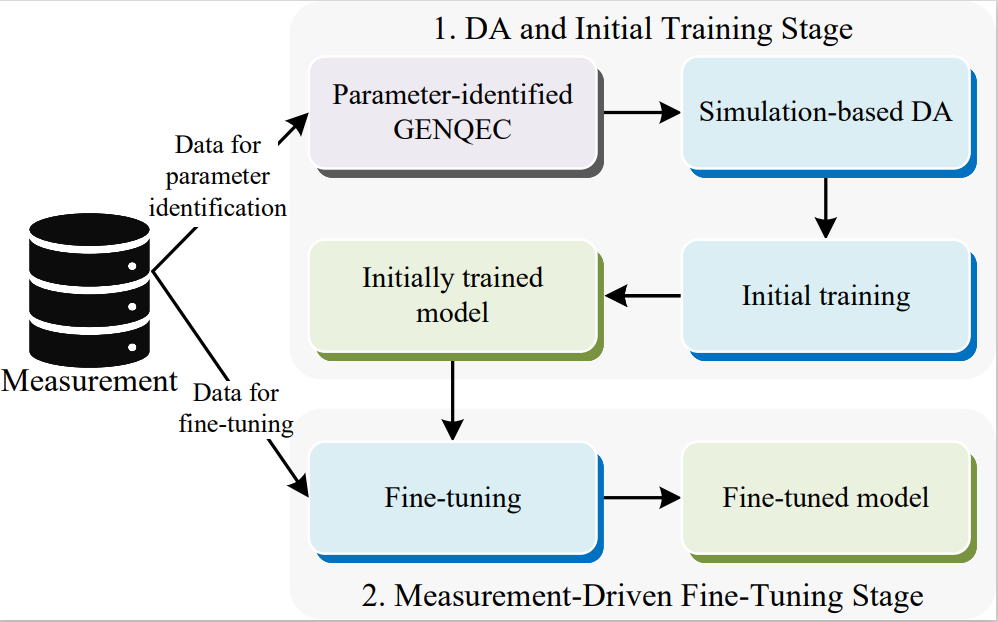
Synchronous generators (SGs) are the cornerstone of modern power systems. However, achieving accurate dynamic modeling of SGs, particularly when considering their complex nonlinear characteristics, has been a persistent challenge for over a century. Neural networks are a promising alternative for SG dynamic modeling, but their training typically lacks sufficient data. To address this, a neural network-based approach for SG dynamic modeling using data augmentation is proposed. The proposed method employs an improved recurrent neural network (RNN) and a practical two-stage learning strategy. In data augmentation and initial training stage, comprehensive data augmentation is performed using physics-based simulations for initial training, and the tailored improved RNN architecture further enables the model to effectively learn and capture dynamics that closely align with physical principles. In measurement-driven fine-tuning stage, scarce real-world measurement data from an in-service generator are used to fine-tune the model, further enhancing its accuracy in real-world operating conditions. Following initial training, the proposed model exhibits generalization ability across diverse fault scenarios, including challenging worst-case and marginal stabilization conditions, accurately replicating physical principles to ensure baseline accuracy and further validating its reliability. Finally, the proposed model achieves a significant relative error reduction compared to the state-of-the-art SG dynamic model, GENQEC, highlighting its potential as a superior alternative for precise SG dynamic representation.
Ke Yang, Xin Wang, Quan Zhang, Renshun Wang, Guangchao Geng*, Quanyuan Jiang ( * corresponding author )
IEEE Transactions on Energy Conversion 2025
Synchronous generators (SGs) are the cornerstone of modern power systems. However, achieving accurate dynamic modeling of SGs, particularly when considering their complex nonlinear characteristics, has been a persistent challenge for over a century. Neural networks are a promising alternative for SG dynamic modeling, but their training typically lacks sufficient data. To address this, a neural network-based approach for SG dynamic modeling using data augmentation is proposed. The proposed method employs an improved recurrent neural network (RNN) and a practical two-stage learning strategy. In data augmentation and initial training stage, comprehensive data augmentation is performed using physics-based simulations for initial training, and the tailored improved RNN architecture further enables the model to effectively learn and capture dynamics that closely align with physical principles. In measurement-driven fine-tuning stage, scarce real-world measurement data from an in-service generator are used to fine-tune the model, further enhancing its accuracy in real-world operating conditions. Following initial training, the proposed model exhibits generalization ability across diverse fault scenarios, including challenging worst-case and marginal stabilization conditions, accurately replicating physical principles to ensure baseline accuracy and further validating its reliability. Finally, the proposed model achieves a significant relative error reduction compared to the state-of-the-art SG dynamic model, GENQEC, highlighting its potential as a superior alternative for precise SG dynamic representation.
Ke Yang, Xin Wang, Quan Zhang, Guangchao Geng*, Quanyuan Jiang ( * corresponding author )
IEEE Transactions on Power Delivery 2025
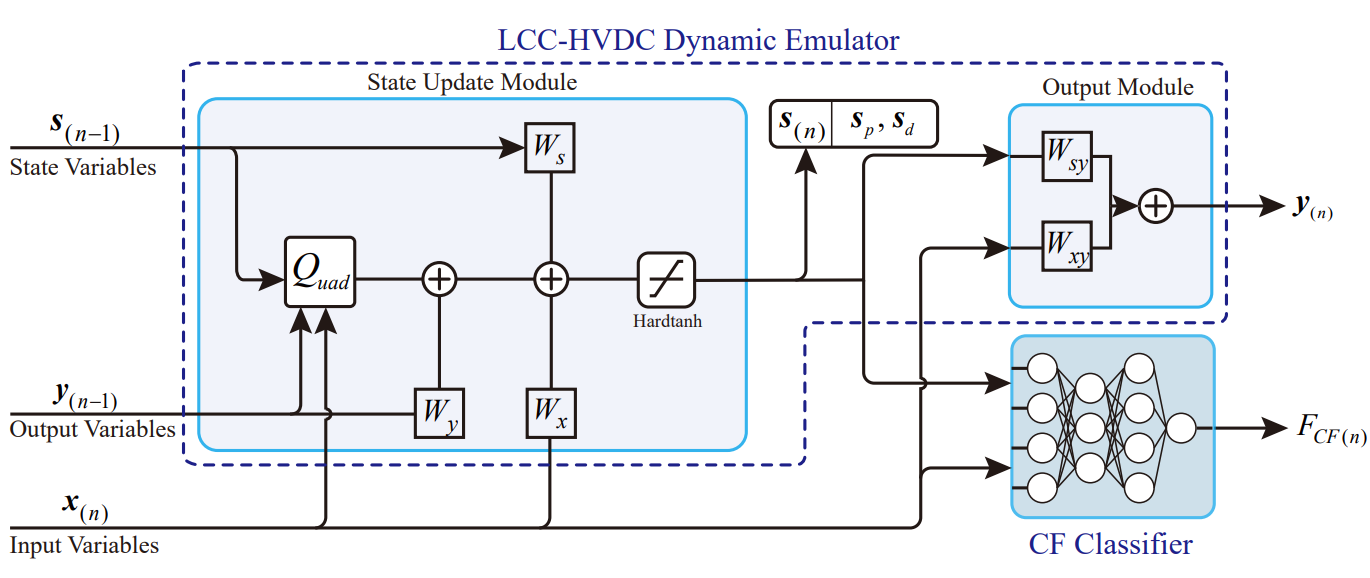
Existing time-domain simulation of LCC-HVDC systems faces a trade-off between accuracy and efficiency. The electromagnetic transient model can accurately emulate detailed dynamic processes, but its computational inefficiency makes it impractical for engineering applications. In contrast, the quasisteady-state model is computationally efficient but fails to adequately express the commutation process of LCC-HVDC systems and is incapable of performing in unbalanced fault scenarios. This paper proposes a neural network-based quasi-steady-state (NN-QSS) model to provide a powerful model for simulating, analyzing, and designing LCC-HVDC integrated power systems. Specifically, the NN-QSS model accurately captures and expresses the LCC-HVDC dynamic characteristics, especially in unbalanced fault scenarios, and is also capable of outputting the identification results of commutation failure occurrences as a sign during quasi-steady-state simulation. The proposed method has been validated using a modified IEEE 39-bus system, an actual provincial power system in China, and a CIGRE benchmark system based on hardware-in-the-loop. The experimental results show that the NN-QSS model is able to express dynamics close enough to electromagnetic transient models at the quasi-steadystate scale, and the commutation failure identification accuracy is improved by 18.8% relative to the existing methods.
Ke Yang, Xin Wang, Quan Zhang, Guangchao Geng*, Quanyuan Jiang ( * corresponding author )
IEEE Transactions on Power Delivery 2025
Existing time-domain simulation of LCC-HVDC systems faces a trade-off between accuracy and efficiency. The electromagnetic transient model can accurately emulate detailed dynamic processes, but its computational inefficiency makes it impractical for engineering applications. In contrast, the quasisteady-state model is computationally efficient but fails to adequately express the commutation process of LCC-HVDC systems and is incapable of performing in unbalanced fault scenarios. This paper proposes a neural network-based quasi-steady-state (NN-QSS) model to provide a powerful model for simulating, analyzing, and designing LCC-HVDC integrated power systems. Specifically, the NN-QSS model accurately captures and expresses the LCC-HVDC dynamic characteristics, especially in unbalanced fault scenarios, and is also capable of outputting the identification results of commutation failure occurrences as a sign during quasi-steady-state simulation. The proposed method has been validated using a modified IEEE 39-bus system, an actual provincial power system in China, and a CIGRE benchmark system based on hardware-in-the-loop. The experimental results show that the NN-QSS model is able to express dynamics close enough to electromagnetic transient models at the quasi-steadystate scale, and the commutation failure identification accuracy is improved by 18.8% relative to the existing methods.
Ke Yang, Xin Wang, Guangchao Geng*, Quanyuan Jiang ( * corresponding author )
IEEE Transactions on Power Systems 2025
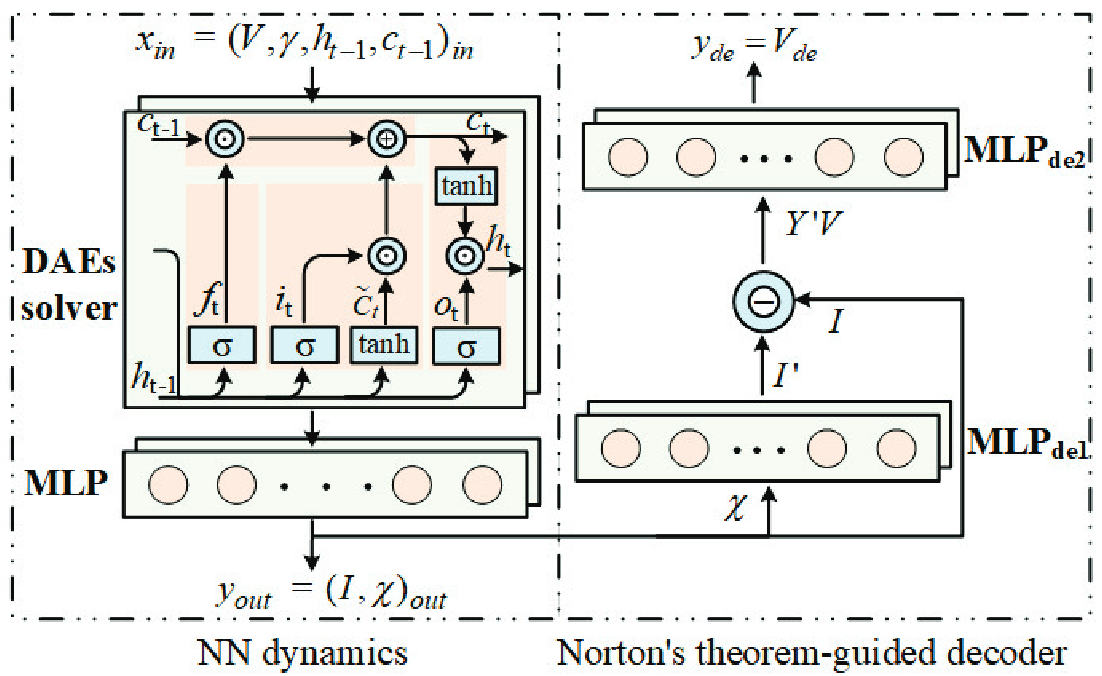
Neural network (NN) dynamics for component modeling in power system is becoming an effective approach to improve model accuracy. However, poor convergence occurs in neural network integrated-time domain simulation (NNI-TDS) with existing numerical methods. To address this challenge, this work studies the impact of NN dynamics on convergence mathematically and develops an integrated fictitious admittance (FA) and successive over-relaxation (SOR) method, which can significantly enhance convergence and shorten simulation time. First, Norton’s theorem-guided decoder is proposed to NN dynamics for FA calculation, and convergence of NNI-TDS can be efficiently enhanced by rebuilding network equations with FA. Then, an NN dynamics-targeted SOR method that considers characteristics of each NN dynamics is proposed for iteration acceleration. Especially, the optimal SOR factors are adaptively determined without additional calculation burdens. Numerical test results on two standard test systems (39 and 2383 buses) and a practical East China Power Grid (5075 buses) illustrate the effectiveness of proposed method. Specifically, faster-than-real-time simulation is realized in test systems even with 100 NN dynamics integrated.
Ke Yang, Xin Wang, Guangchao Geng*, Quanyuan Jiang ( * corresponding author )
IEEE Transactions on Power Systems 2025
Neural network (NN) dynamics for component modeling in power system is becoming an effective approach to improve model accuracy. However, poor convergence occurs in neural network integrated-time domain simulation (NNI-TDS) with existing numerical methods. To address this challenge, this work studies the impact of NN dynamics on convergence mathematically and develops an integrated fictitious admittance (FA) and successive over-relaxation (SOR) method, which can significantly enhance convergence and shorten simulation time. First, Norton’s theorem-guided decoder is proposed to NN dynamics for FA calculation, and convergence of NNI-TDS can be efficiently enhanced by rebuilding network equations with FA. Then, an NN dynamics-targeted SOR method that considers characteristics of each NN dynamics is proposed for iteration acceleration. Especially, the optimal SOR factors are adaptively determined without additional calculation burdens. Numerical test results on two standard test systems (39 and 2383 buses) and a practical East China Power Grid (5075 buses) illustrate the effectiveness of proposed method. Specifically, faster-than-real-time simulation is realized in test systems even with 100 NN dynamics integrated.
Xin Wang, Ke Yang, Wenqi Huang, Yunfei Ma, Guangchao Geng*, Quanyuan Jiang ( * corresponding author )
Proceedings of the CSEE 2024 Journal
Data-driven modeling has shifted the traditional paradigm of generator modeling, making traditional electromechanical transient simulation methods incompatible. This paper proposes a data and physics-driven time domain simulation (DPD-TDS) algorithm. In this algorithm, generator state variables and node injection currents are calculated via data-driven model inference, while node voltages are solved through network equations. A preprocessing method for network algebraic equations is proposed to improve convergence. Furthermore, a CPU-NPU heterogeneous computing framework is designed to accelerate simulation, where the CPU handles differential-algebraic equations and the NPU performs forward inference of data-driven models. Validations on IEEE-39 and Polish-2383 systems demonstrate high accuracy, fast calculation speed, and good convergence.
Xin Wang, Ke Yang, Wenqi Huang, Yunfei Ma, Guangchao Geng*, Quanyuan Jiang ( * corresponding author )
Proceedings of the CSEE 2024 Journal
Data-driven modeling has shifted the traditional paradigm of generator modeling, making traditional electromechanical transient simulation methods incompatible. This paper proposes a data and physics-driven time domain simulation (DPD-TDS) algorithm. In this algorithm, generator state variables and node injection currents are calculated via data-driven model inference, while node voltages are solved through network equations. A preprocessing method for network algebraic equations is proposed to improve convergence. Furthermore, a CPU-NPU heterogeneous computing framework is designed to accelerate simulation, where the CPU handles differential-algebraic equations and the NPU performs forward inference of data-driven models. Validations on IEEE-39 and Polish-2383 systems demonstrate high accuracy, fast calculation speed, and good convergence.
Ke Yang, Xin Wang, Jiajie Ling, Guangchao Geng*, Quanyuan Jiang ( * corresponding author )
Proceedings of the CSEE 2024
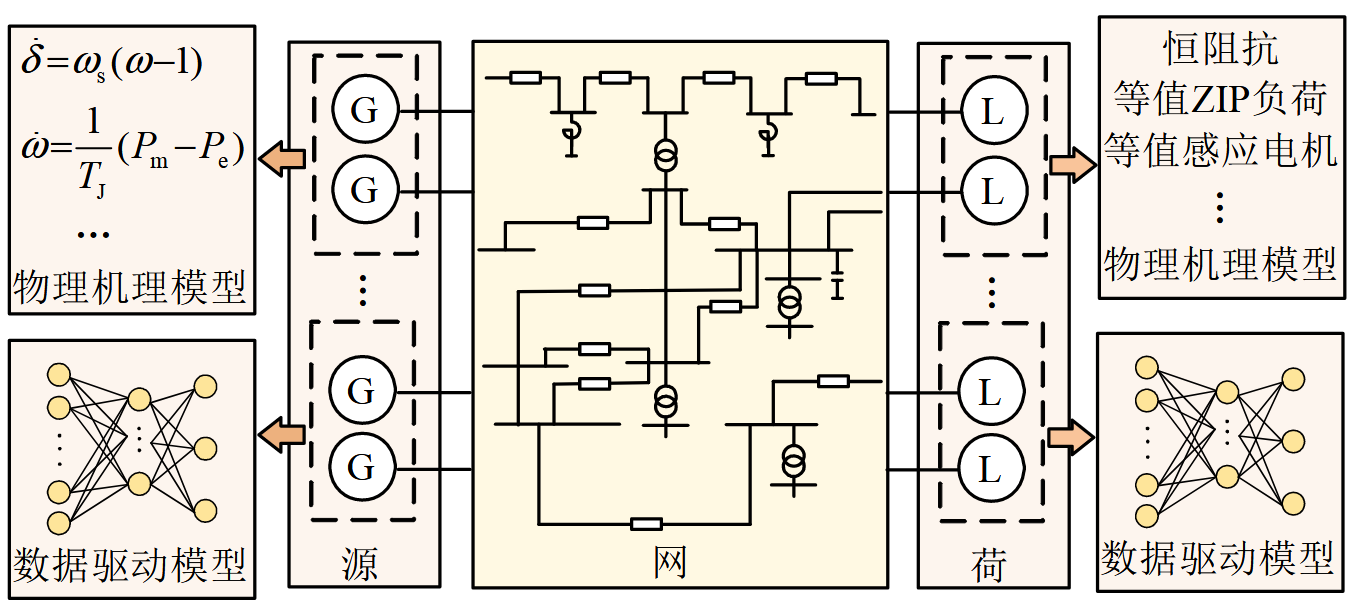
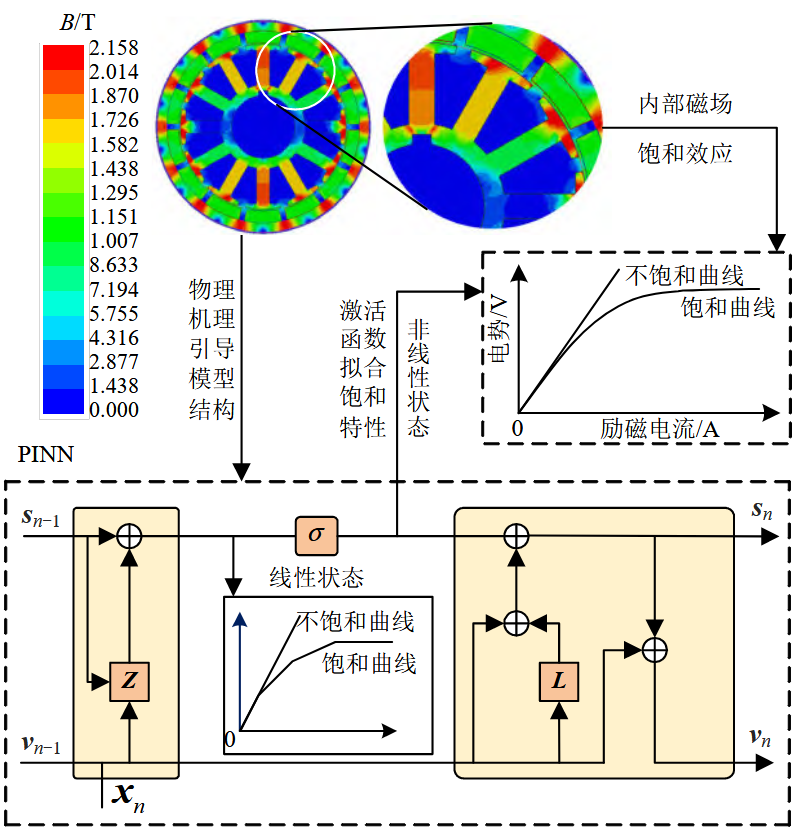
The synchronous generator (SG) models constructed based on physical principles have limitations in accurately capturing the nonlinear characteristics of the SG. Hence, the power system is continuously researching and adopting new SG models to enhance their accuracy. Data- driven models have stronger nonlinear expression capabilities, but they face challenges in practical applications for SG modeling, such as weak model generalization and high data requirements. To overcome these problems, this paper proposes a physics-informed neural network (PINN) model for SG, employing recurrent neural network as the fundamental model architecture. The modelling of the PINN is guided by the physical mechanism of SG and based on the principles of neural network modeling. The PINN can express the magnetic saturation characteristic of SG with high accuracy and has strong generalization ability. It can achieve higher fitting accuracy for SG models of various orders with small-scale data and can be applied to existing electromechanical transient simulation algorithms.
Ke Yang, Xin Wang, Jiajie Ling, Guangchao Geng*, Quanyuan Jiang ( * corresponding author )
Proceedings of the CSEE 2024
The synchronous generator (SG) models constructed based on physical principles have limitations in accurately capturing the nonlinear characteristics of the SG. Hence, the power system is continuously researching and adopting new SG models to enhance their accuracy. Data- driven models have stronger nonlinear expression capabilities, but they face challenges in practical applications for SG modeling, such as weak model generalization and high data requirements. To overcome these problems, this paper proposes a physics-informed neural network (PINN) model for SG, employing recurrent neural network as the fundamental model architecture. The modelling of the PINN is guided by the physical mechanism of SG and based on the principles of neural network modeling. The PINN can express the magnetic saturation characteristic of SG with high accuracy and has strong generalization ability. It can achieve higher fitting accuracy for SG models of various orders with small-scale data and can be applied to existing electromechanical transient simulation algorithms.